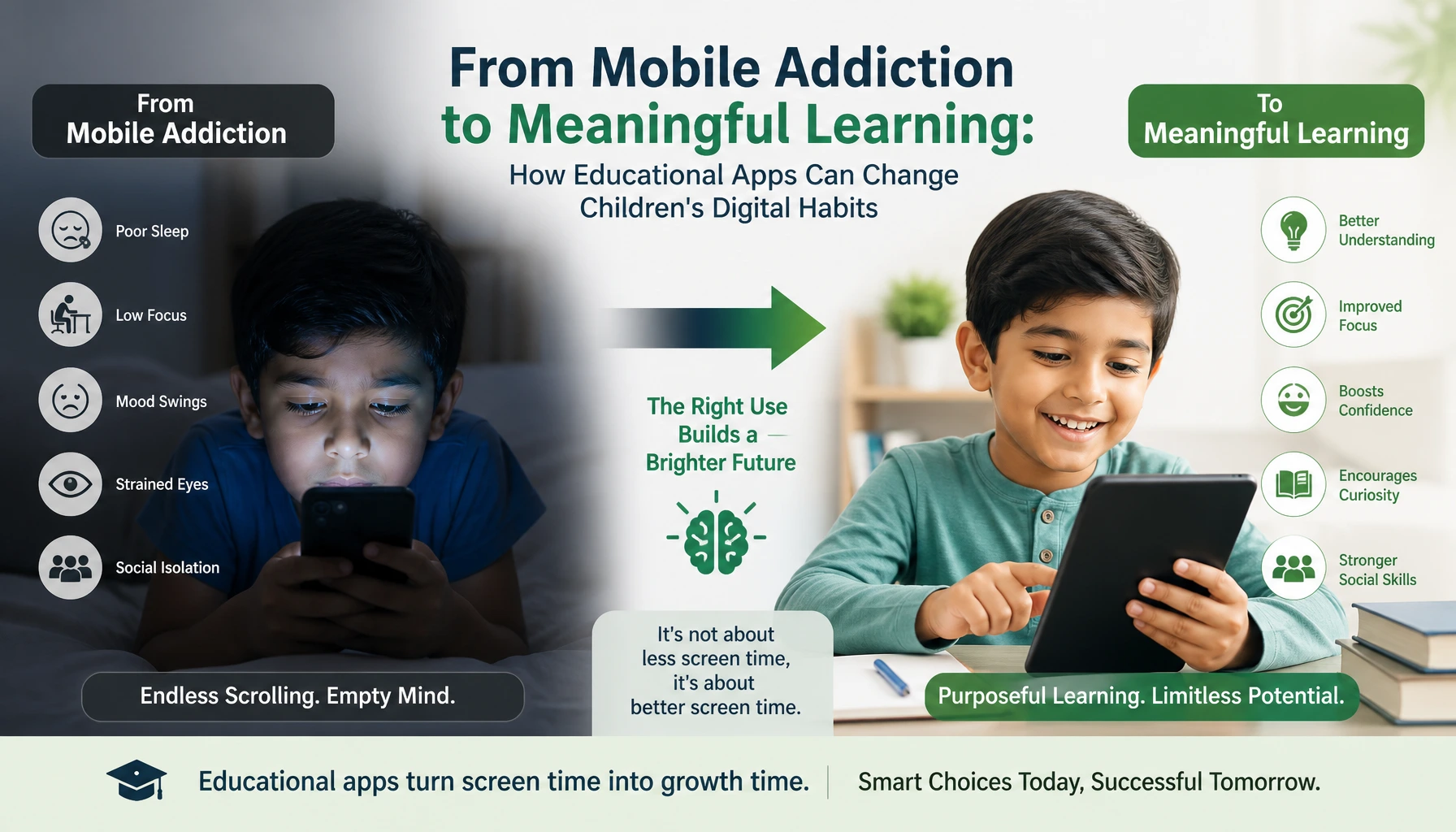
Mobile phones have become a familiar part of modern childhood. Children use smartphones and tablets to watch cartoons, play games, explore videos, and communicate with family members. While these devices offer access to unlimited information, they also create a challenge for parents: how can children enjoy technology without becoming overly dependent on digital entertainment?
Simply taking away a smartphone may not always be the best solution. Children need guidance to understand how technology can be used productively. One practical approach is to introduce educational activities that make children curious about learning rather than constantly searching for entertainment.
A thoughtfully designed kids learning app can help make this transition possible by turning everyday digital interactions into opportunities for knowledge, creativity, and skill development.
Why Children Are Attracted to Mobile Phones
Children naturally enjoy activities that provide immediate entertainment and excitement. Colourful animations, attractive sounds, interactive games, and continuously changing videos can easily capture their attention.
Compared with these activities, reading textbooks or practising mathematics may sometimes appear less exciting to young learners.
However, children are also naturally curious. They enjoy discovering new things, answering questions, identifying objects, solving puzzles, and competing in friendly challenges.
The key is to connect this natural curiosity with educational activities.
Instead of allowing mobile usage to revolve entirely around entertainment, parents can introduce digital learning experiences that encourage children to think, explore, and participate.
Five Ways Educational Apps Encourage Better Digital Habits
1. Introduce Learning Through Everyday Questions
Children frequently ask questions about the world around them.
Why does it rain? How many planets are there? Which animal is the tallest? Why do we need plants?
A good educational platform can turn these everyday questions into interesting learning opportunities.
General knowledge quizzes, science questions, picture-based exercises, and educational activities help children discover answers while developing their understanding of different subjects.
This makes learning an ongoing activity rather than something restricted to school hours.
2. Make Mathematics Less Difficult
Mathematics is an important subject, but some children find calculations and number concepts challenging.
Educational applications can make mathematics practice more interesting through interactive questions, number games, addition, subtraction, multiplication, and division exercises.
For example, parents can encourage children to complete a short mathematics quiz every day. Repeated practice can help them become more familiar with numbers and improve their confidence.
The objective is to make children comfortable with mathematical thinking instead of making every practice session feel like an examination.
3. Improve English Vocabulary and Language Skills
Language development requires regular exposure to new words and opportunities to use them.
Kids learning apps can introduce vocabulary exercises, spelling activities, word matching, grammar questions, and simple English quizzes.
Children can gradually learn new words, understand their meanings, and improve their language knowledge through regular practice.
Parents can strengthen this learning by asking children to use newly learned words in everyday conversations.
4. Develop Curiosity Through General Knowledge
General knowledge helps children understand the world beyond their classrooms.
Topics such as animals, countries, famous personalities, historical events, inventions, science, and geography can introduce children to a wide range of subjects.
Interactive general knowledge questions make it easier to explore these topics in small, manageable learning sessions.
Children may also become more interested in asking questions and discovering information independently.
5. Encourage Logical Thinking Through Puzzles and Challenges
Learning is not limited to memorising information. Children also need opportunities to observe, compare, analyse, and solve problems.
Puzzles, reasoning exercises, matching games, and pattern-recognition activities provide opportunities to practise these skills.
When children attempt a challenge and discover the correct solution, they get an opportunity to understand the process behind the answer.
These experiences can support the development of logical thinking and problem-solving abilities.
How Parents Can Replace Random Mobile Usage with Educational Activities
Parents do not need to completely change their children’s routines overnight. Small adjustments can gradually encourage healthier technology habits.
Here are some practical ideas:
Replace random videos with learning activities: When children ask for a mobile phone, parents can sometimes suggest a short educational quiz or interactive learning activity instead.
Create a daily learning challenge: Encourage children to answer five general knowledge questions or solve a few mathematics problems every day.
Connect digital learning with real-life experiences: After learning about plants through an educational activity, encourage children to observe plants in the garden.
Encourage reading alongside digital learning: Combine educational applications with storybooks, picture books, and age-appropriate reading materials.
Set clear device boundaries: Establish suitable screen-time schedules and ensure that digital activities do not replace sleep, physical exercise, family interaction, or outdoor play.
Appreciate curiosity: Praise children when they ask questions, explore new subjects, or try to solve difficult problems.
Digital Learning and Traditional Education Should Work Together
Educational applications are not replacements for teachers, classrooms, textbooks, or parental guidance.
Traditional education provides structured learning, classroom interaction, communication skills, and opportunities to participate in group activities.
Digital educational platforms can complement these experiences by providing additional practice and interactive exercises.
For example, a child studying multiplication at school can use an educational quiz to practise multiplication tables at home. Similarly, a child learning about animals can explore additional facts through general knowledge questions.
This combination of classroom education, home learning, and carefully managed digital activities can create a more engaging learning environment. Get the official Sarkari Result details on this page.
What Makes a Kids Learning App Useful for Modern Families?
Parents should focus on educational value rather than the number of features an application offers.
An effective educational platform should provide:
- Interactive questions and answers.
- Age-appropriate educational content.
- Mathematics and English practice.
- General knowledge and science topics.
- Puzzles and logical reasoning activities.
- Simple navigation suitable for children.
- Clear explanations that help children understand mistakes.
- A safe and distraction-conscious learning experience.
A good platform should encourage children to participate in learning activities without using unnecessary notifications, excessive rewards, or endless engagement techniques.
Building a Healthy Daily Learning Routine for Children
A balanced routine can help children enjoy both technology and offline activities.
For example, parents can introduce a simple daily schedule:
| Activity | Suggested approach |
|---|---|
| Reading | Read an age-appropriate storybook |
| Mathematics | Practise a few number-based questions |
| English | Learn new words and spellings |
| General knowledge | Explore interesting facts and quizzes |
| Outdoor activities | Play, walk, cycle, or participate in sports |
| Creative activities | Drawing, colouring, crafts, and storytelling |
The time allocated to each activity should depend on the child’s age, needs, and family routine.
Educational screen sessions should remain limited and purposeful. Children also need sufficient sleep, movement, social interaction, and opportunities to explore the world without a device.
KidsLearningApp.com: Making Learning More Enjoyable
Finding suitable educational resources can sometimes be challenging for parents who want to make their children’s digital experiences more productive.
KidsLearningApp.com aims to provide an accessible learning destination where children can explore educational topics, practise questions, participate in quizzes, and develop their knowledge through engaging learning activities.
Rather than focusing only on entertainment, parents can introduce children to activities that encourage curiosity and educational development.
Whether a child wants to practise mathematics, improve English vocabulary, explore general knowledge, or answer interesting questions, educational activities can make learning a more enjoyable part of everyday life.
Parents can explore KidsLearningApp.com as a supplementary learning resource and incorporate suitable activities into their children’s home-learning routines.
Conclusion: Teach Children to Use Technology Wisely
The future will be increasingly digital, and children will naturally interact with technology throughout their education and professional lives.
Therefore, teaching children how to use digital devices responsibly is just as important as managing their screen time.
A kids learning app can help parents introduce meaningful digital activities that encourage knowledge, curiosity, and regular practice.
However, the best learning environment combines technology with books, outdoor games, creativity, classroom education, and family interaction.
Instead of asking how to keep children away from technology forever, parents should focus on teaching them how to use technology to discover, learn, and grow.