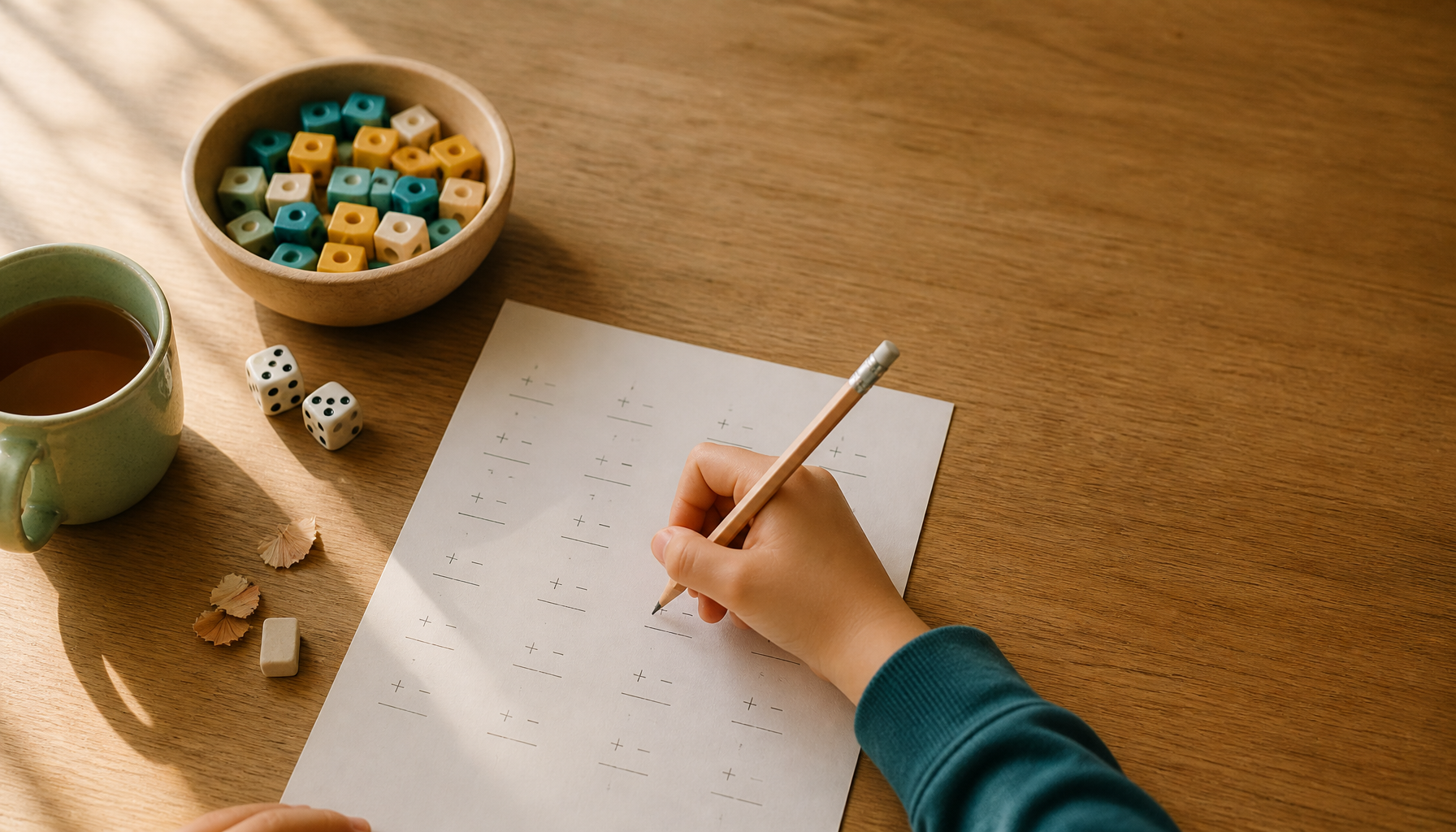
My niece once filled in forty subtraction problems in nine minutes flat, handed the page over, and said she still didn’t know what subtraction was. She wasn’t being cheeky. She’d spotted the pattern in the column, copied it down the page, and finished. That’s the thing about Maths Worksheets — they’re only as good as the thinking they demand. Used well, a single page can do more for a child’s number sense than an hour of app-tapping. Used badly, it’s colouring-in with digits.
So this is the guide I wish someone had handed me years ago: how to pick worksheets that pull their weight, how to pair them with activities that make the ideas stick, and how to keep the whole thing to ten minutes so nobody ends up crying into their pencil case.
Why Maths Worksheets Still Earn Their Place
There’s a fashion for dismissing paper practice as old-fashioned. I don’t buy it. Writing by hand slows a child down just enough for the maths to register. There’s no hint button, no animated character doing a dance when they get it right, no sound effects pulling their attention sideways. Just a problem and a pencil.
Paper also makes thinking visible. When a child works on screen, you see a right or wrong tick. On paper you see the crossed-out attempt, the little tally marks in the margin, the place where they started carrying and gave up. That margin scribble tells you more about what’s going wrong than any score ever will.
And there’s the plain fact of fluency. Multiplication facts, number bonds, halving and doubling — these need repetition until they’re automatic, because a brain busy calculating 7 × 8 has no capacity left for the actual problem. Short, regular written practice is still the most reliable way to get there.
What Separates a Useful Worksheet from Busywork
Here’s my rough test. If a child can finish a page without ever changing their mental approach, the page is too easy or too repetitive. Good practice varies the shape of the question so the brain has to re-engage.
- Mixed formats. 12 + 9 = ___ and ___ + 9 = 21 and 12 + ___ = 21 are the same fact dressed three ways. A sheet with all three builds far more flexibility than twenty of the first.
- A sensible quantity. Twelve to twenty questions is usually plenty. Forty is a stamina test, not a maths test.
- Space to work. Cramped boxes force children to do everything in their heads, then blame themselves for slipping.
- One or two stretch questions at the end. Something open — “find two numbers that add to 21” — gives faster children somewhere to go.
- Clean layout. Cartoon borders and clip-art eat ink and attention. Plain is fine.
When you’re hunting for material, look for collections that progress in small steps rather than jumping from easy to hard. A well-organised bank of Maths Worksheets sorted by topic and year group saves you the evening of scrolling and second-guessing, and it means you can hand a child the next logical page rather than something random that happens to be lying around.
Matching the Page to the Child’s Stage
Age labels are a guide, not a verdict. Plenty of eight-year-olds need number bond practice meant for six-year-olds, and that’s completely normal. Go by what they can do confidently, not by what the school calendar says.
Ages 4–6: building the picture
At this stage, worksheets should lean heavily on pictures, dots and simple counting. Tracing numerals, matching quantities to symbols, spotting what comes next in a sequence. Keep sessions under five minutes. The goal is comfort with numbers, not speed.
Ages 6–8: facts and place value
Number bonds to 10 and 20, the two, five and ten times tables, tens and ones. This is the window where fluency pays its biggest dividends. Short daily practice beats a long weekend session every time.
Ages 9–11: multi-step and reasoning
Long multiplication, fractions, decimals, word problems with more than one step. Here the worksheet needs room for working out, and you should care more about the method than the final number.
| Age range | Focus | Session length |
|---|---|---|
| 4–6 | Counting, number recognition, patterns | 3–5 minutes |
| 6–8 | Number bonds, tables, place value | 8–10 minutes |
| 9–11 | Written methods, fractions, word problems | 12–15 minutes |
Activities That Make the Practice Stick
A worksheet is the rehearsal. The activity is the performance. Pair them and the maths lands properly.
- Shop at home. Price up items from the cupboard with sticky notes, hand over a few coins, let them buy and give change. Brilliant for addition, subtraction and money sense all at once.
- Dice wars. Two dice each, roll and multiply, highest product wins the round. Ten minutes of this does the work of a whole tables sheet, and they’ll ask for another go.
- Cooking with fractions. Halve a recipe. Double it. Ask what three quarters of a cup looks like next to a half. Fractions stop being abstract the moment they’re edible.
- Measure the house. Tape measure, notebook, a list of things to find the perimeter of. Add a column for estimates first — estimation is wildly underrated.
- Card snap to ten. Spread cards face up, grab pairs that total ten. Fastest hand wins. Number bonds, sorted.
- Journey maths. In the car: how many minutes until we arrive if we’re going 60 and we have 30 miles left? Messy, approximate, genuinely useful.
The Ten-Minute Routine That Avoids a Standoff
Most maths battles at home aren’t about maths. They’re about length, timing and tone. Fix those three and resistance usually drops away.
Set a timer and honour it. Ten minutes means ten minutes, even if the page isn’t finished. Children work far harder when they can see the end.
Pick a consistent slot. After breakfast, before screens, whatever fits — but the same time daily. Negotiating the when is exhausting for everyone.
Do the first question together. It kills the blank-page dread without taking over.
Mark it in front of them, straight away. Delayed feedback is weak feedback. And when something’s wrong, ask “talk me through this one” rather than “that’s not right.” You’ll often find the misconception in about twenty seconds.
Stop before frustration arrives, not after. If three questions in a row go badly, the sheet is too hard. Put it away, do something easier, come back in a week. Pushing through teaches children that maths is a thing that makes them feel stupid — a lesson that takes years to undo.
Reading the Mistakes
Errors aren’t noise. They’re the most useful data you’ll get. A child who writes 43 − 27 = 24 isn’t guessing; they’re subtracting the smaller digit from the larger one in each column, which is a perfectly logical rule that happens to be wrong. Spot that and you can fix it in one conversation.
Keep a scrap of paper with recurring slip-ups on it. After a fortnight you’ll see a pattern — maybe every error involves crossing a ten, or every fraction mistake involves unlike denominators. Then you choose the next worksheet to target exactly that, rather than hoping general practice washes it out.
Where to Go From Here
Don’t overhaul everything. Pick one topic your child finds wobbly, find three or four worksheets that build on each other, and commit to ten minutes a day for two weeks. Pair each page with one of the activities above so the maths escapes the paper and shows up in the kitchen or the car.
Two weeks is usually enough to see movement — not mastery, but the sort of quiet confidence where they stop asking whether they got it right. That shift matters more than any score. Keep the sessions short, keep the tone light, and let the worksheets do their one job well: steady, unglamorous practice that builds something real underneath.
Frequently Asked Questions
How long should a child spend on maths worksheets each day?
For under-sixes, three to five minutes is plenty. Six to eight-year-olds manage around ten minutes, and nine to eleven-year-olds can handle twelve to fifteen. Short and daily beats long and occasional.
Are worksheets better than maths apps?
They do different jobs. Apps are great for motivation and instant feedback, while paper slows children down and makes their thinking visible so you can spot misconceptions. Most families get the best results using both.
What should I do if my child keeps getting the same type of question wrong?
Treat it as a clue rather than carelessness. Ask them to talk you through their method out loud — repeated errors almost always come from a consistent, logical rule that’s slightly off, and naming it usually fixes it fast.
Should I use worksheets below my child’s school year group?
Absolutely, if that’s where the gap is. Confidence is built on fluency, and practising an easier skill until it’s automatic frees up mental space for harder work later. Nobody needs to know which year the sheet came from. Check the latest Sarkari Result updates here.
How do I stop maths practice turning into an argument?
Use a visible timer, keep a fixed daily slot so the when isn’t up for debate, and stop before frustration sets in rather than after. Ending on a question they can do is worth more than finishing the page.
How many questions should a good worksheet have?
Usually twelve to twenty, with mixed question formats and a couple of open-ended stretch problems at the end. Forty near-identical sums tests stamina, not understanding.